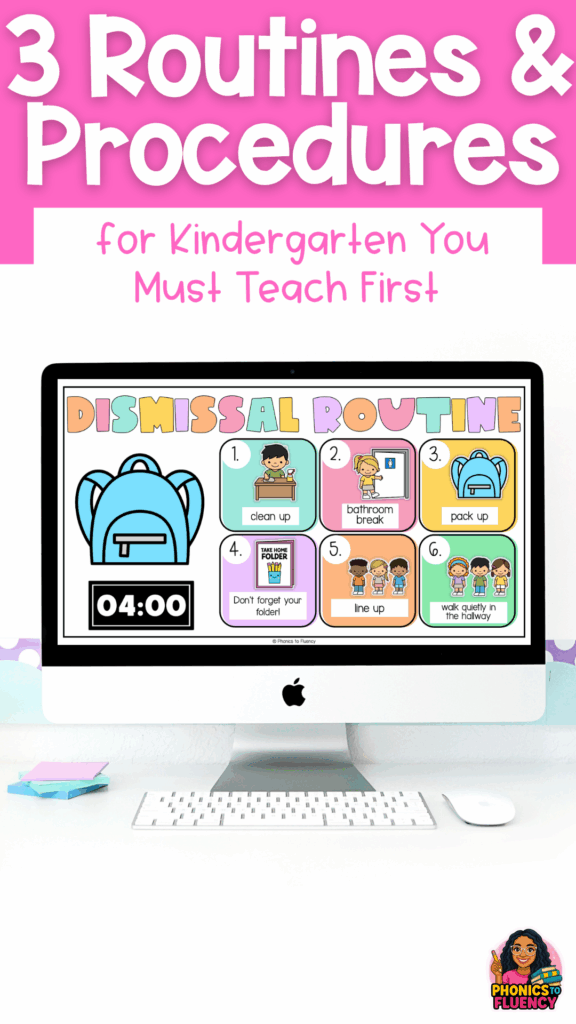
3 Routines and Procedures for Kindergarten You Must Teach First
The first month of school isn’t just about getting to know your students; it’s about building the foundation for the entire year. A classroom that “runs itself” doesn’t happen by magic, it happens by intentionally and explicitly teaching the right routines and procedures for Kindergarten from Day 1.
If you’re feeling overwhelmed by the sheer number of procedures you need to teach, take a deep breath. Focus on these three non-negotiable categories first, and you’ll solve 90% of your classroom management issues before they even start.

1. The Arrival & Morning Routine
The Problem: The first 15 minutes of the day can be pure chaos. Students are coming in, parents have questions, and you’re trying to take attendance. Without a clear system, you’ll start every single day feeling frazzled.
The Solution: Create a “Morning Flow” that is so predictable, students can do it with their eyes closed by week two. It needs to be visual and consistent.
Your Morning Flow Checklist:
- Unpack: Where does the backpack go? The lunchbox? The homework folder?
- Sign In: How do they “check in” for the day? (e.g., moving their name tag, a digital check-in)
- Morning Work: What is the exact activity they should begin immediately and silently?
Pro-Tip: Practice this entire sequence multiple times a day for the first week. Make it a game! Time them and see if they can beat their record.

2. Managing Transitions
The Problem: More instructional time is lost during sloppy transitions than anywhere else. Lining up, coming to the carpet, switching subjects, or getting into groups can take forever and invite misbehavior.
The Solution: Treat every transition like a mini-lesson. Use clear, simple auditory and visual cues.
Your Transition Taming Toolkit:
- Use a Signal: A chime, a call-and-response, or a specific song clip that means “time to transition.”
- Give a Time Limit: “You have 30 seconds to quietly put your math book away and get out your writing journal.”
- Set Clear Expectations: “What does it look like when we walk to the carpet? (Silent feet). What does it sound like? (Nothing).”


3. Managing Supplies & Materials
The Problem: “I need a pencil!” “Where do the scissors go?” “I’m out of glue!” Constant interruptions about supplies derail your teaching and create learned helplessness.
The Solution: Your students should know exactly how to get, use, and return every common classroom supply without ever asking you.
Your Supply System Must-Haves:
- Pencil Procedures: Have a “sharp” and “needs sharpening” cup system. Teach them how and when they can sharpen pencils.
- Label Everything: Every bin, every drawer, every shelf. Use pictures for younger students.
- Model, Model, Model: Don’t just tell them how to clean a paintbrush; show them. Then have them show you.
From Blueprint to Reality (Without the Burnout)
Knowing what to teach is one thing.
Having everything ready to go is another.
If you’re reading this and thinking, “This is great, but I don’t have time to create all of these materials,” I’ve got you.
That’s exactly why I created the Primary Classroom Playbook.
Instead of piecing together ideas from Pinterest, Facebook groups, and random downloads, you’ll get instant access to a growing library of 50+ classroom management resources, SEL supports, Mini Trainings, implementation guides, custom GPTs, and classroom tools designed to help you build routines and procedures you can actually keep up with all year long.
The goal isn’t to give you one more thing to manage.
The goal is to give you a plan.
So you can spend less time scrambling to create materials and more time getting your classroom ready for the first day.
Save These Tips for a Chaos-Free First Month
Be sure to save this post so you can come back to it as you plan for back to school! Just add the pin below to your favorite classroom management or back to school ideas board on Pinterest.
You’ll be able to quickly find this post when you’re ready to set up your classroom for a smooth and successful school year.